Not sure about you, but I binge-watched all OpenAI episodes last week. In case you missed it, here is a fantastic piece that summarizes all the twists and turns, and all the best memes of the OpenAI Saga.
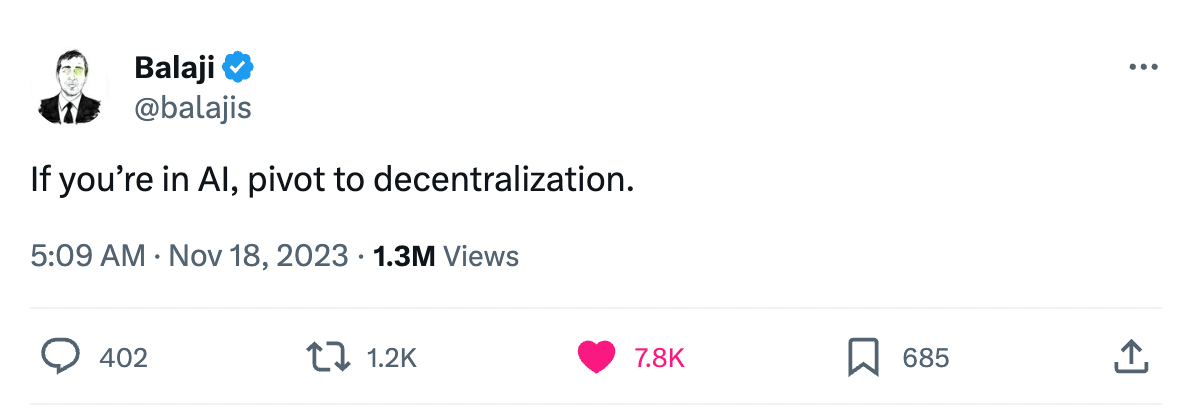
But most importantly, it exposes the concentration risk of advanced AI technology. Imaging Microsoft to shut down the servers on which OpenAI models run. All the ChatGPT-powered software or software systems will break down, impacting hundreds of thousands of businesses. Inevitably, AI needs to be decentralized.
Market catches up on this narrative in no time. In fact, the decentralized AI category within the crypto market jumped 10% to 12% in total market cap during the OpenAI Saga with leaders such as Fetch.ai enjoying a 50% increase in market cap.

In this post, we will discuss the leading AI projects in web3 as well as some emerging ones.
The market leaders
First, let’s look at the projects with token launched, listed and have a sizable market cap.
Fetch.ai
Fetch probably is the best-known name among all AI coins. It is a decentralized artificial intelligence (AI) network that aims to empower developers to create intelligent and autonomous agents. The platform uses blockchain technology to enable secure, decentralized transactions while also incorporating smart contracts and multi-agent systems. It also features a decentralized data marketplace, where individuals and organizations can buy and sell data and AI services.

Why AI agents?
I assume everyone who are reading this is already familiar with ChatGPT or Claude.ai. While you can ask questions and get some answers. They can’t do things for you automatically. And often times, to arrive at an ideal answer, you end up writing lengthy prompts. We even have a new occupation now called prompt engineer. That is where Fetch.ai comes in. Fetch takes it one step further and create AI agents that will complete tasks on you behalf (hence the name). Neat, isn’t it?
The Agentverse
One important part of Fetch ecosystem is the Agentverse. The Agentverse is a cloud-based IDE for developing and deploying AI agents. AI agents deployed on Agentverse can be discovered and used by a wide variety of services and use cases. Furthermore, the autonomous agents on the decentralized network can communicate and transact with each other.
The FET token
FET (Fetch.ai Token) is the native cryptocurrency of the Fetch.ai network. It is an ERC-20 token built on the Ethereum blockchain. FET is used as a utility token within the Fetch.ai ecosystem to facilitate various activities and transactions. These include accessing and utilizing the services provided by autonomous agents on the Fetch.ai network, participating in consensus mechanisms, and rewarding network participants for their contributions. FET tokens can be used for staking, paying for services, and incentivizing behavior within the Fetch.ai network. At the time of this article, FET has a market cap around $500 million.
Team behind Fetch
The Founder and CEO of Fetch.ai is Humayun Sheikh. In the past, he was a founding investor in Google DeepMind where he supported commercialization for early-stage AI & deep neural network technology. Fetch.ai is backed by DWF Labs, Bitget Exchange among others.
Bittensor
Interestingly, you don’t hear mainstream crypto influencers talking about Bittensor although it is the No.1 AI coin by market cap. Regardless, it has a loyal cult following. Bittensor is a layer 1 blockchain that is built on its own blockchain infrastructure, which is specifically designed for the project’s decentralized artificial intelligence network. This allows for secure and efficient processing of AI-related tasks and ensures the integrity of the network.
Machine Intelligence Mechanism
It adopts an innovative market system that generates machine intelligence. Bittensor introduces a mechanism where machine intelligence is valued by other intelligence systems through peer-to-peer interactions. Peers rank each other by training neural networks to learn the value of their neighbors, and scores are recorded on a digital ledger. High-ranking peers receive additional weight in the network. The system also includes an incentive mechanism to prevent collusion. Overall, this creates a machine intelligence market that generates new models and rewards participants who contribute valuable information to the system.
Blockchain Consensus Mechanism
The BitTensor project utilizes a Proof-of-Stake (PoS) consensus mechanism to secure and validate transactions on its decentralized network. In a PoS consensus mechanism, participants in the network can “stake” their tokens as collateral to become validators and contribute to the block validation process. The probability of being chosen as a validator is proportional to the number of tokens staked. This approach aims to provide a more energy-efficient and scalable alternative to traditional Proof-of-Work (PoW) mechanisms.
Token $TAO
$TAO is the native cryptocurrency of the TAO Bittensor network. It is used as a means of exchange and incentive for participants who contribute their computing resources and AI knowledge to the network. $TAO can be earned through various activities such as training AI models, sharing AI knowledge, and validating transactions on the network. It can also be used to access certain features and services within the TAO Bittensor ecosystem. As a cryptocurrency, $TAO can be traded on various cryptocurrency exchanges. At the time of this article, $TAO has a market cap around $1.2 billion.
Projects to watch
We are still very early in this decentralized AI journey, with new projects coming in every other day. One project I’d like to highlight here is Gensyn, a London-based decentralized AI company that raised $43 million Series A round earlier 2023, led by a16z.
Gensyn.ai
Straight from their website: “The Gensyn Protocol is a layer-1 trustless protocol for deep learning computation that directly and immediately rewards supply-side participants for pledging their compute time to the network and performing ML tasks.”
The problem it is solving
In order to develop and continue to refine large foundation models (such as GPT-4 by OpenAI), enormous amount of computing power is required. GPT-3 model used a cluster of 1,000 NVIDIA Tesla V100 GPUs for training, for example. The level of resources required to develop a large language model is prohibitively high and is only possible for a handful of tech giants on the earth. On top of that, these large language models are not all open-source. GPT is not. The barrier to entry together with the closed door development approach create significant concentration risk. Gensyn is on a mission to change the status quo by developing a decentralized marketplace which facilitate the trading of computing power by anyone, anywhere.
It is taking the idea of the distributed computing power of older projects such as SETI@home and the COVID-19 focussed Folding@home, and applies it in deep learning amongst AI developers.
I have to say this is a noble idea that aims to tackle an incredible important issue that potentially threaten the sheer existence of human specie. Without a doubt, this is an uphill battle with countless challenges such as work verification, privacy issue etc. It is still early days, but I resonate with the mission and I wish the team best of luck.

A Gensyn token?
It is mentioned in its litepaper that a token will be issued at the Token Genesis Event (TGE) by the Gensyn Foundation. However, there is no timeline in regard to when this will take place.
2 responses to “When Decentralization Meets AI”
I couldn’t agree more
Wow, this blog post is incredibly informative and highlights the importance of decentralization in AI. The mention of Fetch.ai and Bittensor as leading projects in decentralized AI is really interesting. I’m curious to know if there are any other projects that you would recommend keeping an eye on in the decentralized AI space? Great article! I really enjoyed reading about the leading AI projects in web3. Could you provide any insights on other emerging projects in the decentralized AI space?
Jean
http://airiches.online/
Hi Jean,
Thanks a lot for your kind words! I am glad you find the post helpful. In terms of other projects, I think Gensyn (building a decentralized marketplace for computing power) is an interesting one to watch in 2024. Other than that, Vaiot is an AI project in legal and Ocean Protocol is in data privacy. This space is brimming with interesting projects for sure!