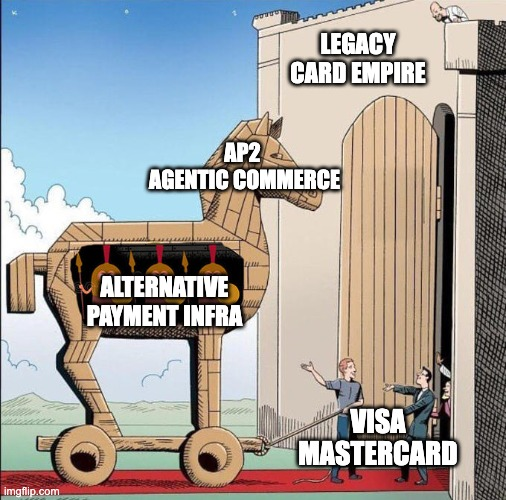
Visa and Mastercard together control about 90% of the global card market today. But tomorrow? They might just be the middlemen AI agents tolerate—until programmable money makes them obsolete. In the age of agentic commerce, is the Trojan Horse at the gates?
Google AP2 101
Google’s Agent Payments Protocol (AP2), unveiled on September 16, 2025, is an open standard turning AI agents into autonomous shoppers. As detailed in Google’s Cloud Blog, AP2 provides a “common language” for secure, compliant transactions between agents and merchants, blending verifiable mandates with blockchain proofs to ensure trust without endless human hand-holding.Think programmable payments on chains like Sui, fused with protocols like A2A for account-to-account flows.
But here’s the pivot: AP2 isn’t merely “AI pays for stuff.” It’s normalizing agent autonomy, letting bots negotiate, authorize, and execute deals independently. With over 60 backers, including Adyen, Amex, Ant, Coinbase, JCB, Mastercard, PayPal, and Revolut, this coalition proves incumbents aren’t idle. They’re co-building the rails, but at what cost to their empires?
Visa/MC’s Counterpunch
Visa and Mastercard aren’t rolling over, they’re counterpunching hard, embedding themselves as the indispensable “trust API” in agentic commerce. Take Mastercard’s Agent Pay, launched April 29, 2025: This pioneering tech uses biometrics and on-device AI for seamless agent authentication, letting your digital deputy shop on your behalf without a password prompt. It’s powering AI-driven commerce by verifying mandates in real-time, turning potential disruption into a revenue stream via their vast network.
Visa matches the intensity with its Intelligent Commerce APIs, rolled out April 30, 2025, which empower AI agents to “find and buy” securely—setting spending limits, tokenizing payments, and integrating fraud protection. These tools make cards the default for agent transactions, positioning Visa/MC as the compliant backbone for AP2’s verifiable ecosystem. In a world of opaque AI decisions, their legacy trust (built on billions of daily auths) becomes essential.
The risk? AP2’s flexibility means agents could reroute to cheaper alternatives if mandates permit. Why stick with 2-3% interchange when A2A or crypto offers near-zero fees? As agents optimize for cost and speed, Visa/MC’s moat might crack, turning their counterpunch into a rearguard action.
Google + Stripe’s Endgame

AP2’s crypto-native design is the detonator, explicitly supporting stablecoin settlements that could vaporize card dependency for swaths of global payments.
Enter Google’s endgame: Its GCUL Layer-1 blockchain, revealed August 27, 2025, targets cross-border finance head-on, challenging Stripe and Circle with neutral infrastructure for banks and processors. GCUL streamlines stablecoin flows, potentially capturing 5-10% of cross-border volumes by enabling instant, low-cost transfers—rivaling SWIFT’s clunky rails.
Stripe amps the blast with Tempo, its September 2025 Layer-1 launch alongside Paradigm: A payments-first chain optimized for stablecoins, boasting EVM compatibility and built-in AMMs for high-volume use cases like remittances and B2B invoices. Tempo’s near-zero fees and 100,000+ TPS could obsolete cards for 40% of global flows—think $690 billion in remittances to low/middle-income countries alone in 2025, plus trillions in B2B cross-border. In agentic commerce, why route through Visa when an AI can settle on-chain? This duo’s programmable money vision erodes inertia, forcing cards into niche irrelevance.
What’s your take? Will cards fade, or adapt?
2 responses to “Is Google’s AP2 the Trojan Horse That Could Replace Visa and Mastercard?”
Concise, practical, and to the point. Thanks for sharing.
Your blog is a breath of fresh air in the often stagnant world of online content. Your thoughtful analysis and insightful commentary never fail to leave a lasting impression. Thank you for sharing your wisdom with us.