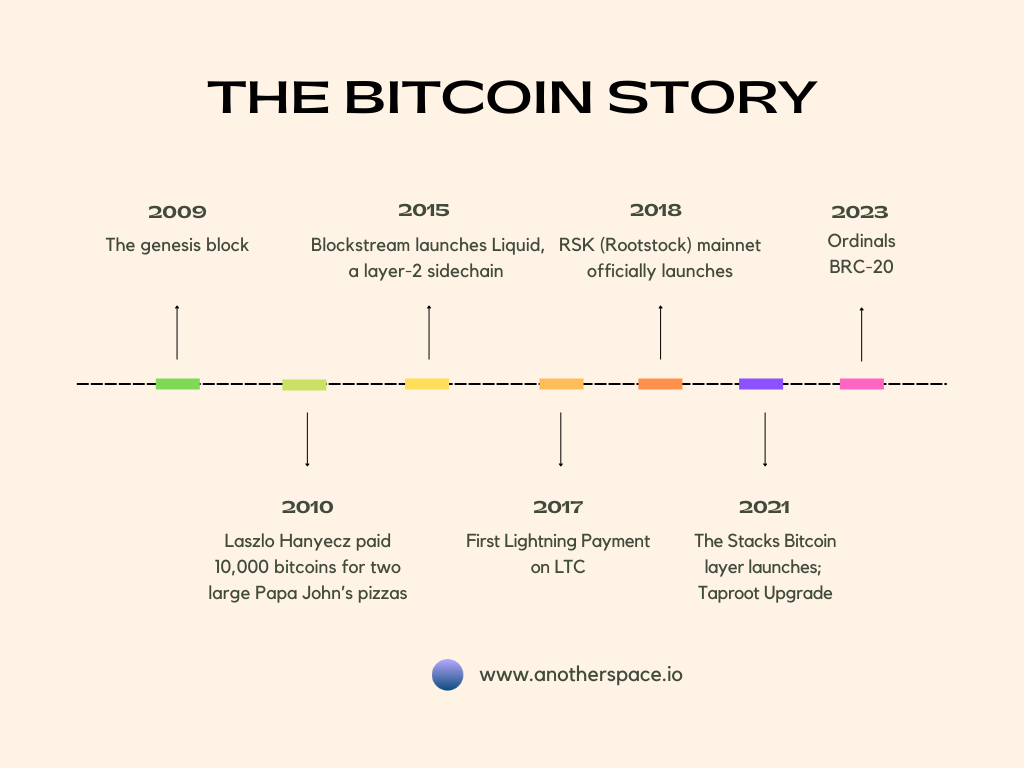
If we take a step back and ask what led to the rise of ethereum or any other alternative layer-1 chains in the first place? It is because the very first blockchain – bitcoin blockchain has scalability issues and it doesn’t have smart contract capabilities. But these limitations are not set in stone. The past few years have witnessed remarkable technology breakthroughs around bitcoin which pave ways to new possibilities for bitcoin, beyond a store of value.
The Bitcoin Story
The year was 2009. Satoshi Nakamoto mined the first block of Bitcoin blockchain. The first block of Bitcoin, also known as the genesis block, contains a message referencing a headline from The Times newspaper about the UK government’s plan to bail out failing banks. This message is significant because it reflects one of the main rationales behind the creation of Bitcoin – to establish an alternative to traditional financial institutions and their centralized control over the economy. The bitcoin ecosystem slowly develops with no significant technological breakthrough until 5 – 6 years later.

In 2015, Blockstream launches Liquid, the first production Layer-2 that attempts to improve the functionality and performance of bitcoin blockchain. And from there, the innovation started to pick up speed.
In 2017, the first payment took place via the Lightening network. Lightning Network is a second layer technology built on top of the Bitcoin blockchain that enables faster and cheaper transactions. It is significant to Bitcoin because it allows for more use cases and makes it more attractive as a payment system.
In 2018, Rootstock (RSK) mainnet officially launches. Rootstock is a layer-2 chain that brings smart contract capabilities to Bitcoin ecosystem. One of the key features of RSK is its compatibility with EVM. This enables developers to easily deploy their EVM dapps on RSK and thus bring their dapps to Bitcoin ecosystem. In fact, RSK acts as an important bridge between Bitcoin and Ethereum ecosystem.
In 2021, this is a phenomenal year for crypto in many ways, no exception for bitcoin blockchain. For one, the famous Taproot upgrade was activated. For another, Stacks – a new blockchain layer was launched in the same year to enable smart contracts for Bitcoin.
The Taproot Upgrade
The Taproot upgrade is a significant change to the Bitcoin protocol that was activated in November 2021. It improves Bitcoin’s privacy, security, and scalability through the introduction of a new type of address called taproot addresses.
- Privacy: Taproot addresses allow for complex smart contracts and payment conditions without revealing all the details on the blockchain. This enhances privacy. Taproot transactions look like regular Bitcoin transactions, making it harder to distinguish what type of transaction it is or what conditions are encoded in the transaction.
- Scalability: It implements a new digital signature scheme called Schnorr signatures. These are more efficient cryptographically than the previous ECDSA scheme, allowing for smaller transaction sizes and lower fees.
- Security: Schnorr signatures also enable complex smart contracts to be created through a mechanism called MAST (Merkelized Abstract Syntax Tree). This allows for conditions like multi-sig to be encoded in a way that looks like a normal transaction.
Who is who in Bitcoin DeFi
The following is a concise infographic of Bitcoin DeFi ecosystem as of July 2023. This map does not intend to be exhaustive. But rather, it aims to provide a birds-eye view of the main characters in the Bitcoin DeFi ecosystem.

DeFi Rails
The main projects that focus on developing bitcoin infrastructures and empower DeFi include Blockstream, Rootstock, Stacks and most recently Ark. Without a doubt, Blocksteam is a pioneer in the space with the launch of both Liquid network and Lightning network. It is then joined by Rootstock in 2018 and Stacks in 2021. In May 2023, Bitcoin developer Burak Keceli introduced Ark, a novel layer 2 protocol. It enhances Bitcoin transactions’ speed, security, and scalability by adopting a distinct scaling approach compared to other layer 2 solutions like Lightning, while still keeping Bitcoin as the base layer.
DEXs
The more established DeFi projects in the Bitcoin ecosystem include Sovryn and Interlay. Most known for its BTC loans and BTC-backed stablecoins, Sovryn also runs a DEX for token swap, spot and margin tradings. Interlay is known for its work in developing decentralized bridges and interoperability solutions for BTC. Within its ecosystem, it has several DEXs include Acala. Alex is a AMM DEX built on top of Stacks. It is the first BRC-20 DEX, and it also features a cross-chain bridge.
Lending/borrowing
One issue many projects aims to tackle is how to increase the capital efficiency of BTC. Sovryn offers Zero, a 0% interest loans when you borrow against your bitcoin. In return, you receive ZUSD (a USD-pegged stablecoin), and can use it to buy more BTC. Interlay issues iBTC on the back of BTC collateral. With iBTC, you can access DeFi dapps in other ecosystem to generate yields.
Stablecoin
Ahead of US presidential candidate Robert Kennedy, some of the DeFi projects are already issuing BTC backed USD. Founded in 2019, Money on Chain is a DeFi projects built on Rootstock. Its core product is RIF Dollar (RDOC), an algorithmic stablecoin pegged 1:1 to the USD, collateralized by RSK network bitcoins. Aside from ZUSD, Sovryn recently launched DLLR. “The Sovryn Dollar will extend and increase the usefulness of DOC and ZUSD, while at the same time improving the resilience of BTC-backed stability as well as increasing the overall liquidity.” – Sovryn Wiki
Yield
Yield comes with liquidity/asset pools. This is so far a less developed area due to lack of liquidity in the ecosystem. The leading lending/borrowing protocols such as Sovryn and Interlay both enable users to generate yield via staking/loan issuance.
Bridges
Bridge Bitcoin ecosystem and Ethereum ecosystem is one of the key missions of the ecosystem. Many leading projects offer a bridge feature that enables different degree of interoperability, such as Alex, Rootstock and Interlay.
Ordinals
Something unique to the bitcoin ecosystem, it is no exaggeration to say Ordinals is one of the catalysts that re-ignited builders interest in the bitcoin ecosystem, among others. Rightfully, we see DeFi projects build around Ordinals. To learn more on this topic, you can read more here.
Payments
Lightning Network is a true game changer to bitcoin payment. It successfully lowers the transaction time from 1 – 1.5 hours to a few seconds/minutes and lowers the transaction cost to a fraction of what it is like before.
Bitcoin ecosystem in numbers
A quick search on DefiLlama shows how early we are in terms of Bitcoin DeFi or Bitcoin ecosystem as a whole.
| Ecosystem Name | TVL | Vol – 24h | Vol – 7D |
| Rootstock | $90.18m | n.a. | n.a. |
| Stacks | $24.12m | $163k | $1.74m |
| Protocol Name | TVL | Vol – 24h | Vol – 7D |
| Money on Chain (Rootstock) | $46.72m | n.a. | n.a. |
| Sovryn (Rootstock) | $24.16m | $126k | n.a. |
| Alex (Stacks) | $18.58m | $71k | n.a. |
Despite Bitcoin being the first cryptocurrency and the foundation of the entire blockchain revolution, its integration into the decentralized finance (DeFi) landscape has been relatively slow compared to other cryptocurrencies like Ethereum.
One reason is the ideological differences between the Bitcoin and DeFi communities. Bitcoin is often associated with being a store of value and a digital gold, emphasizing security and scarcity over smart contract functionality. On the other hand, DeFi is more focused on building complex financial instruments and applications on top of blockchain networks.
As the crypto space continues to evolve, it is possible that we will witness more innovative solutions to bring DeFi to Bitcoin blockchain, enhancing the overall liquidity and utility of the ecosystems. Additionally, the growth of layer 2 solutions and other interoperability protocols may play a crucial role in bridging Bitcoin and Ethereum blockchains.
One response to “Back To The Origin: Bitcoin DeFi”
[…] is the major reason of the rise of etheruem, solana and the rest layer one chains. In my previous post, I wrote about the class of 2017 builders who pioneered the bitcoin ecosystem. This post will focus […]