If you are seed to Series A and you plan to raise in the next 3–6 months, here is the uncomfortable truth:
Most fundraising timelines slip because the founder story is unclear or the follow-ups take too long. You cannot control investor calendars. You can control whether your finance answers land in hours versus weeks.
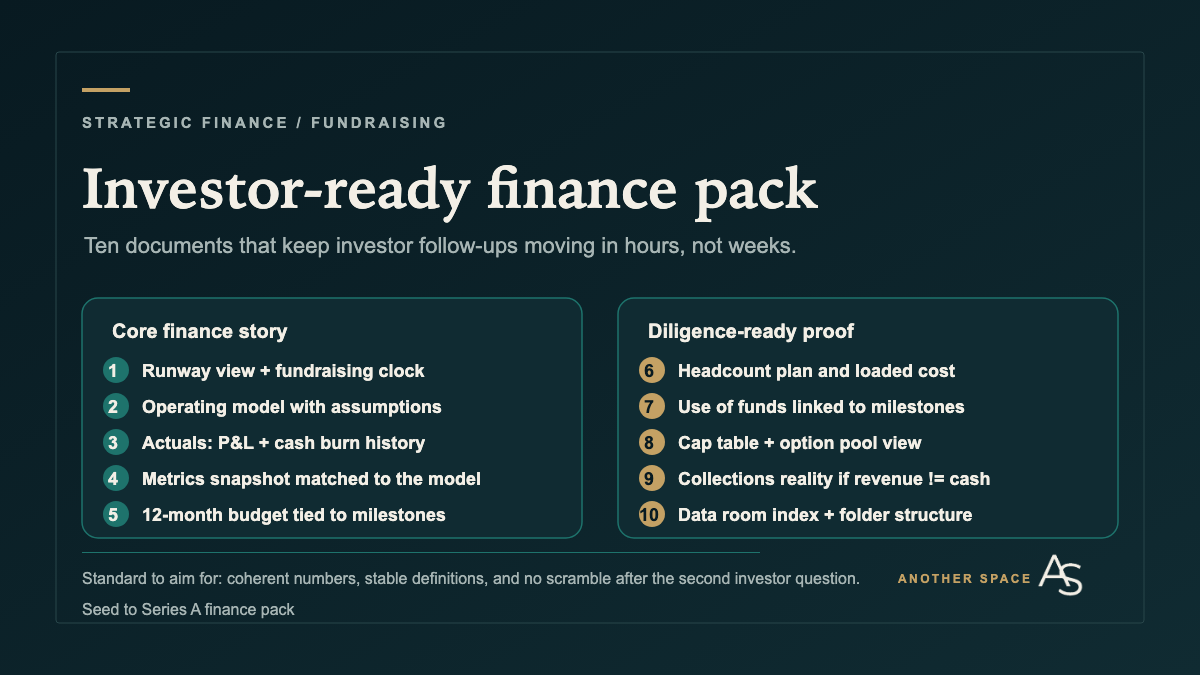
This post is a practical checklist: the “investor-ready finance pack” I want founders to have before they email the first investor.
It is not a giant data room. It is a small set of materials that (1) reduces back-and-forth, (2) increases investor confidence, and (3) keeps you from building the plane mid-flight.
What “Investor-Ready” Actually Means
Investor-ready does not mean perfect formatting or a 30-tab model.
It means:
– You can explain how you make money in two minutes.
– Your runway math ties to the plan you are pitching.
– Your numbers reconcile (model ↔ actuals ↔ bank balance).
– When an investor asks a follow-up, you have an artifact ready to share.
If your finance pack meets those standards, you will feel the difference immediately: fewer awkward pauses, fewer “let me get back to you,” and fewer credibility hits.
The Investor-Ready Finance Pack (Seed → Series A)
Below are the 10 materials I recommend. You can keep these in a single folder and refresh monthly during a raise.
1) A One-Page Runway View (With a Fundraising Clock)
This is the artifact most founders think they have, but usually don’t.
Include:
– Current cash balance and last month’s burn
– Base-case cash-out month
– A “decision date” (when you must change plan or start a process)
– A fundraising timeline line (e.g., “materials ready,” “process start,” “target close”)
The point is not precision. The point is forcing the calendar conversation early.
2) A Simple Operating Model (With Assumptions You Can Defend)
At seed/Series A, investors don’t need a dissertation. They need a model that is:
– Coherent
– Assumption-driven
– Easy to audit
Minimum viable structure:
– Revenue drivers (volume, conversion, price, retention)
– Gross margin assumptions
– Headcount plan (by month/quarter)
– Non-headcount spend (tools, cloud, contractors)
– Cash waterfall (starting cash → cash-out)
If your model cannot be explained quickly, it will not be trusted.
3) Last 6–12 Months of Actuals (P&L + Cash Burn), Clean Enough to Explain
You don’t need GAAP perfection. You do need:
– A consistent chart of accounts
– A clear separation between one-time and recurring items
– A way to answer “why did burn spike last month?”
Founders lose trust when actuals look like a personal credit card statement.
4) A Metrics Snapshot That Matches Your Business Model
Pick the 8–12 metrics that actually describe your business, not a copy-paste SaaS dashboard.
Examples by model:
– B2B SaaS: ARR/MRR, gross margin, net revenue retention (if relevant), churn, pipeline coverage
– Usage-based: active usage, expansion, top cohorts, gross margin by usage tier
– Marketplace: liquidity, take rate, contribution margin, supply/demand growth
The key is consistency: define the metric once and keep the definition stable during the raise.
5) A Budget View (Next 12 Months) Tied to Milestones
This is where the “why now” story gets operational.
Show:
– The next milestone (what you must prove)
– The spend required to pursue it (headcount and non-headcount)
– What you would cut first if things slip
Investors are not only buying the idea. They are buying your ability to manage cash.
6) A Headcount Plan (Roles, Timing, and Fully-Loaded Cost)
Do not show only “we’ll hire 8 people.”
Show:
– Roles by function
– Hiring timing ranges (best case / base case)
– Fully-loaded costs (salary + taxes/benefits + recruiting + equipment)
If you don’t know fully-loaded cost, your burn forecast is usually off by more than you think.
7) A Use-of-Funds Table That Connects Dollars → Milestones
This is where founders accidentally lose credibility with vague phrases like “growth” or “R&D.”
A good use-of-funds table answers:
– What will the dollars buy?
– What milestone will that unlock?
– What changes if you raise 20% less or 20% more?
8) A Current Cap Table + Option Pool View (and a Simple Dilution Story)
You do not need to negotiate terms in a first meeting.
You do need to know:
– Current ownership (founders, employees, prior investors)
– Reserved option pool
– What you think you need to create/refresh
– The rough dilution range you are planning for
If you can’t answer cap table questions quickly, you risk delaying the process at exactly the wrong time.
9) A “Collections Reality” Page (If You Have Revenue)
For many startups, “revenue” and “cash” are not the same thing.
Include:
– Billing terms (annual vs monthly, net terms, prepay vs arrears)
– Aging snapshot (how much is overdue)
– Any concentration risks
This is especially important if your bookings are lumpy or your customers pay slowly.
10) A Lightweight Data Room Index (So You Don’t Panic Later)
You don’t need a full diligence library on day one. But you should have an index and a place to put things.
At minimum, create a folder structure with:
– Finance (model, actuals, bank statements if requested)
– Legal (entity docs, major contracts)
– Security/IT (if relevant)
– HR (headcount, key policies)
The goal is to avoid scrambling when an investor asks, “Can you share X?”
A Practical Build Plan: Do This in Two Short Sprints
If this feels like a lot, run it as two sprints:
Sprint 1 (2–3 hours): draft the pack with placeholders.
– Create the folder
– Build the one-page runway view
– Export last 6–12 months of actuals
– Draft the model assumptions (even if rough)
Sprint 2 (2–4 hours): tighten and reconcile.
– Make the model tie to actuals where it should
– Define metrics clearly (and lock definitions)
– Write a one-paragraph explanation for any weird line item
You are not trying to impress with complexity. You are trying to be fast, consistent, and credible.
The Founder Benefit
When your finance pack is ready before you fundraise, three things happen:
1. You move faster through follow-ups (less calendar drag).
2. You sound more credible (because your answers are consistent).
3. You stay in control of the story (because you are not reacting in panic).
If you’re planning to raise this year, build this finance pack now even if the round is months away.
If you want a quick sanity check, ask yourself: “Could I answer the next five investor follow-ups today without building anything new?” If the answer is no, this checklist is your starting point.
Leave a Reply