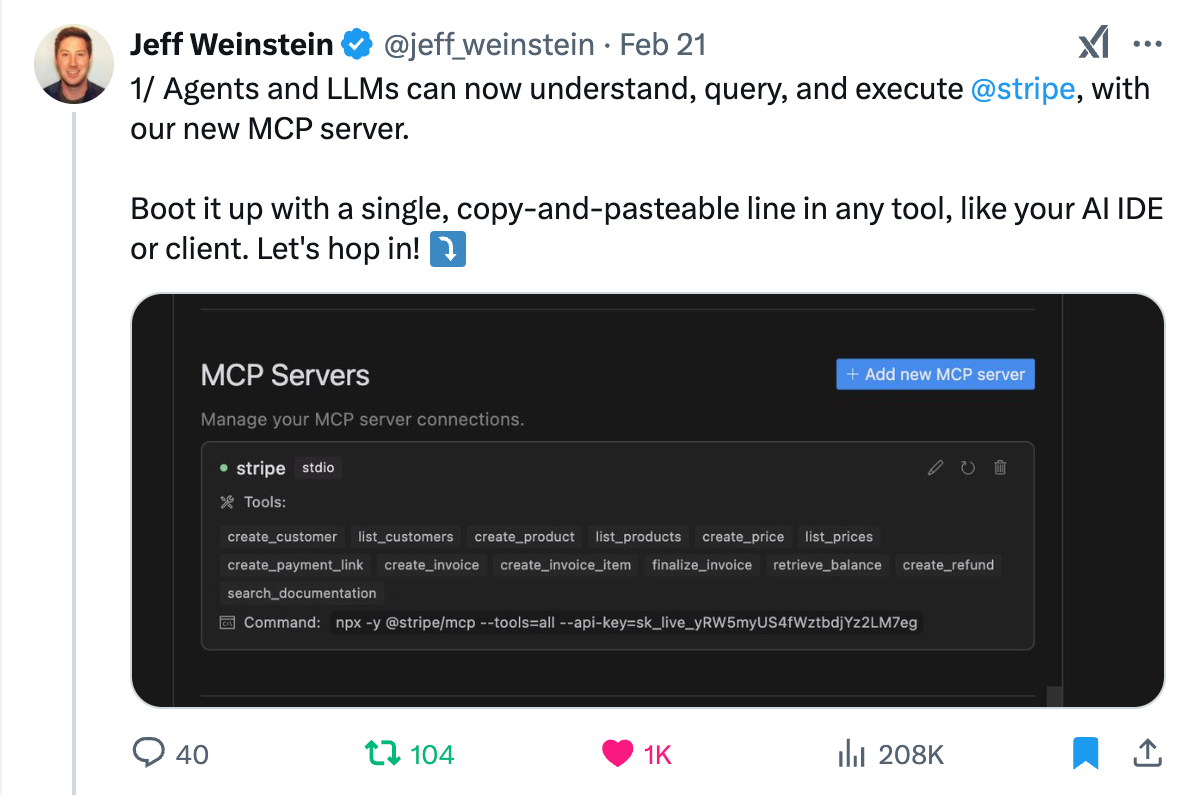
Stripe recently unleashed its Model Context Protocol (MCP) server, a fintech bombshell. This isn’t just another API tweak—it’s a seismic shift, letting AI agents tap Stripe’s payment powerhouse with a single command. For fintech startups and giants, it’s a game-changer: imagine an AI issuing invoices, managing subscriptions, or refunding customers mid-conversation. Stripe, the $65 billion titan that processed about $1.4 trillion last year, is betting big on AI to redefine commerce.
What is Model Context Protocol (MCP)?
Model Context Protocol (MCP), is an open-source standard developed by Anthropic. MCP is designed to connect AI systems, particularly large language models (LLMs), with external data sources and tools in a standardized way. An MCP server is a lightweight program that acts as an intermediary, exposing specific capabilities—like accessing files, querying databases, or interacting with APIs—to an AI client (e.g., Claude Desktop or another MCP-compatible application).
One Line of Code, Endless Possibilities
Here’s the startup candy: npx -y @stripe/mcp –api-key=YOUR_KEY. That’s it—one line, and your AI is plugged into Stripe’s universe. No months of coding, no bloated dev teams. For a fintech startup, this is gold: your AI can create customers, manage subscriptions, or process payments instantly. Stripe’s MCP server, built on Anthropic’s open-source protocol, hands startups a shortcut to compete with the big guys. Need to test a subscription model? Done. Want to automate refunds? Easy.
With Data Security at Heart
Stripe’s MCP server hands startups an AI superpower—and MCP’s architecture is the secret sauce democratizing it. Fintech’s AI race often locks out small players, but MCP’s open-source standard, born from Anthropic’s safety-first ethos, levels the field. With Stripe’s one-line launch (npx -y @stripe/mcp –api-key=YOUR_KEY), a startup can plug AI into payments—no big budget needed. The real kicker? MCP’s design bakes in data security: strict access controls, encrypted channels, and scoped permissions mean your AI can query customers or tweak subscriptions without risking leaks. X posts (e.g., @stripe_dev_sol ) rave about its “guardrails with freedom”—perfect for fintech startups dodging GDPR or PCI-DSS pitfalls.
The Future of Payment
Stripe’s MCP server is a catalyst for fintech and AI commerce. By handing AI agents the keys to financial tools, Stripe sets a precedent: expect rivals like Square or Adyen to counter with their own AI plays. For startups, it’s a democratizing force—cheap, fast integration levels the playing field, sparking a wave of AI-driven payment innovations.
As AI gets savvier, MCP’s open-source roots (cheers to Anthropic) might spawn a toolbox explosion, reshaping how money moves online. This isn’t just Stripe’s moment—it’s a blueprint for a smarter, faster financial future.