Decentralized social refers to a type of social network that operates on a decentralized infrastructure, rather than relying on a centralized authority or company to manage user data and content. A decentralized social network has two prominent characteristics. For one, it is censor-resistant. We are all (at some point) witnesses of censorship on popular Web2 social media platforms. For another, each user’s identity is independent of a given platform, so it is portable. Similar to crypto wallets that can connect with any DeFi dapp without registration, a user’s identity profile should be able to move freely among different decentralised social apps without re-filling a profile page.
Decentralized social network is not a new concept. Mastodon, for example, is a pioneer decentralized social platform founded in 2016. It is a free, open-source social network that is built on top of the ActivityPub protocol. Mastodon allows users to create accounts and communicate with each other through a network of independent, interconnected servers. Mastodon is a passion project started and supported by users and developers who are committed to building and promoting a decentralized and user-centric social network. It has no direct revenue streams or monetization model. Each Mastodon instance has it is own funding model, mostly coming from donations or corporate sponsorships.
However, if you think about it, Mastodon is not really a decentralized social network in the sense that: 1) your personal profile is not portable. As shown below, you can only log in to the server you registered. Joining another server will require creating a new account; 2) it is not completely censor-free. Each server has its own management team that creates its own rules. It might be more accurate to say that Mastodon is a micro-centralized-social network collective. In fact, the creator of Nostr (Notes and Other Stuff Transmitted by Relays) started Nostr because his pro-bitcoin group was ousted on Mastodon.

Entering Damus built on Nostr. Damus is a decentralized social network championed by Twitter co-founder Jack Dorsey. After selling Twitter to Elon Musk, Jack went on to create the decentralized version of Twitter – Damus powered by Nostr. A firm bitcoin believer, Jack donated 14 bitcoin (or approximately $245,000) to @fiatjaf (the anonymous founder of Nostr) to fund the development of Nostr — the protocol that powers Damus. The app went live on both Apple and Android app stores on 31 January 2023. Unlike Mastodon, Damus doesn’t rely on server(s). It also doesn’t require emails or phone numbers to sign up. In the simplest words, it allows people to exchange encrypted messages via a network of relays. I don’t think I can summarize its technical differentiation better than the team itself so below is an excerpt from Nostr official website.
Nostr at a high level
- There are two main components: clients & relays. Each user runs a client. Anyone can run a relay.
- Every user is identified by a public key. Every post is signed. Every client validates these signatures.
- Clients fetch data from relays of their choice and publish data to relays of their choice. Relays don’t talk to one another, only directly to users.
- For example, to “follow” someone a user just instructs their client to query the relays it knows for posts from that public key.
I signed up for Damus out of curiosity and it took me about 10 seconds. On your profile page, you would see the number of relays next to your following and followers. Below is what a Damus profile looks like. Another key product feature that many Nostr users are drawn to is its compatibility with the Lightning Protocol. Everyone on Nostr can seamlessly transact Bitcoin micropayments, facilitating creator tips and content payments of any size. Although there are enough big names and financial resources backing the project to stimulate fast scaling and user acquisition, it is still very early days. The protocol itself, quoting the founder, is not ready for mass adoption.

Blockchain infrastructure is a natural choice for developing decentralized social apps. After DeFi Summer and Metaverse Autumn, it looks like we now embrace the DeSo Season. The most prominent one out there is Lens Protocol founded by AAVE founder Stani Kulechov. Lens Protocol is built on Polygon (a Layer 2 chain of Ethereum), which allows for secure and transparent transactions and provides users with greater control over their data and content. It also includes features such as smart contracts, which automate the process of licensing and selling visual content, and a decentralized storage system for storing and accessing visual assets. Lens profile mint is open to its early supporters only. However, you can always grab one on Opensea if you are keen to try out the platform in its existing state.

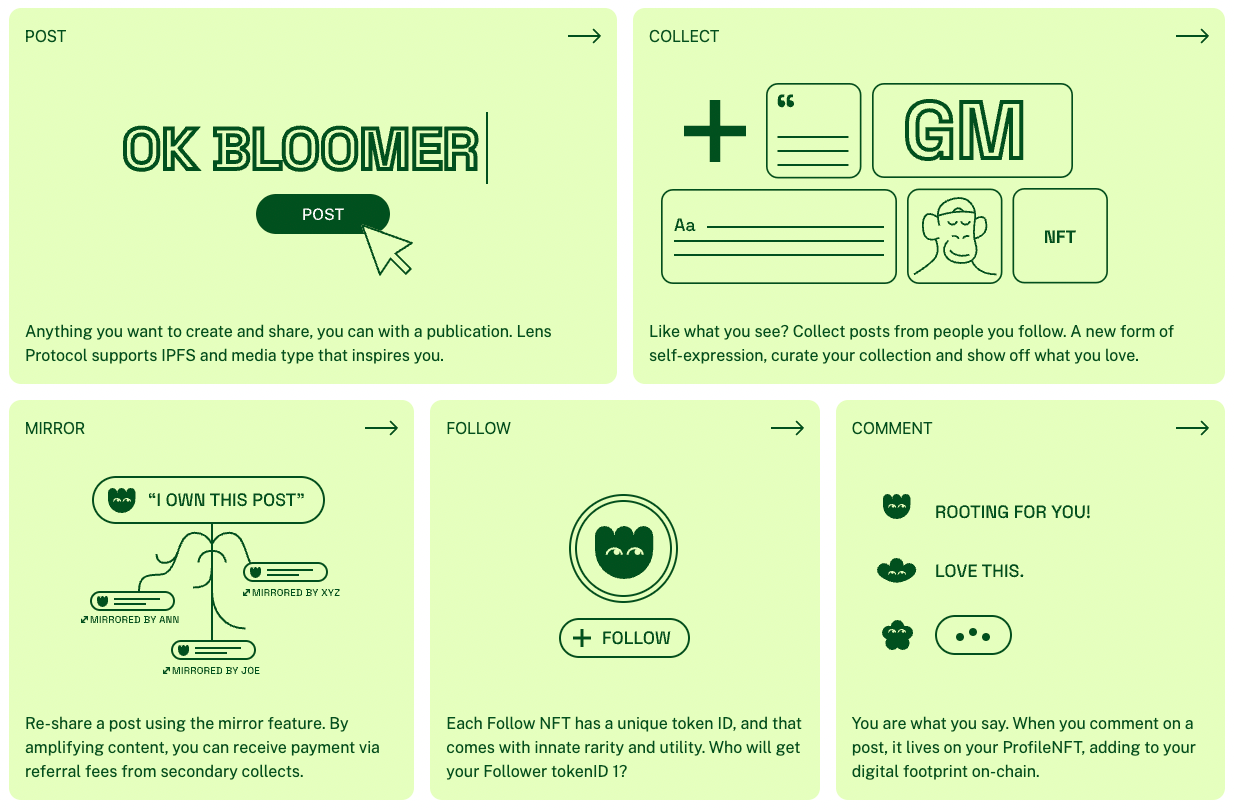
Similar to Damus, Lens meets the two characteristics of a decentralized social app. However, unlike Damus, Lens is built on a public blockchain in Ethereum ecosystem. The monetization model on Lens is also more versatile. Each action on Lens Protocol will be turned into a NFT which then can be monetized. (e.g. comment, follow, mirror). The target audience is more geared towards visual creators. Lens Protocol is still in development, and it remains to be seen how successful it will be in achieving its goals. However, the concept of a decentralized social network and marketplace for visual creators is an interesting one, and could have the potential to disrupt the traditional models of content creation and distribution.