Today we are going to delve into the evolution from Liquid Staking Tokens (LST) to Liquid Restaking Tokens (LRT). Different from the 2021 – 2022 bull market, this bitcoin ETF-led bull run is often criticized for lacking technology innovations. LRT is undoubtedly an innovation that takes the most mind share this time around. Let’s dive in.
Liquid staking and liquid restaking
Liquid Staking is an additional feature built on top of vanilla crypto staking. In first iteration of staking, users’s crypto assets are locked for that purpose only. A liquid staking protocol increases capital efficiency by issuing a receipt token to users when users stake their tokens. The receipt token can be traded on exchanges. Today, Lido Staked Eth (stETH) is one of the top ten crypto assets with a FDV around $28 billion. Other major players in Ethereum liquid staking include Rocket Pool, Binance and Mantle.
So what is liquid restaking then? Users that stake ETH can opt-in to a restaking smart contracts to restake their ETH and extend cryptoeconomic security to additional applications on the network. The first and foremost application of liquid restaking, therefore, lies in its ability to aggregate and extend cryptoeconomic security through restaking and to validate new applications being built on top of Ethereum. Further afield, liquid restaking tokens can be used to secure other blockchain networks other than Ethereum. The following is a useful comparison of LST and LRT. You can access the full report here.

EigenLayer
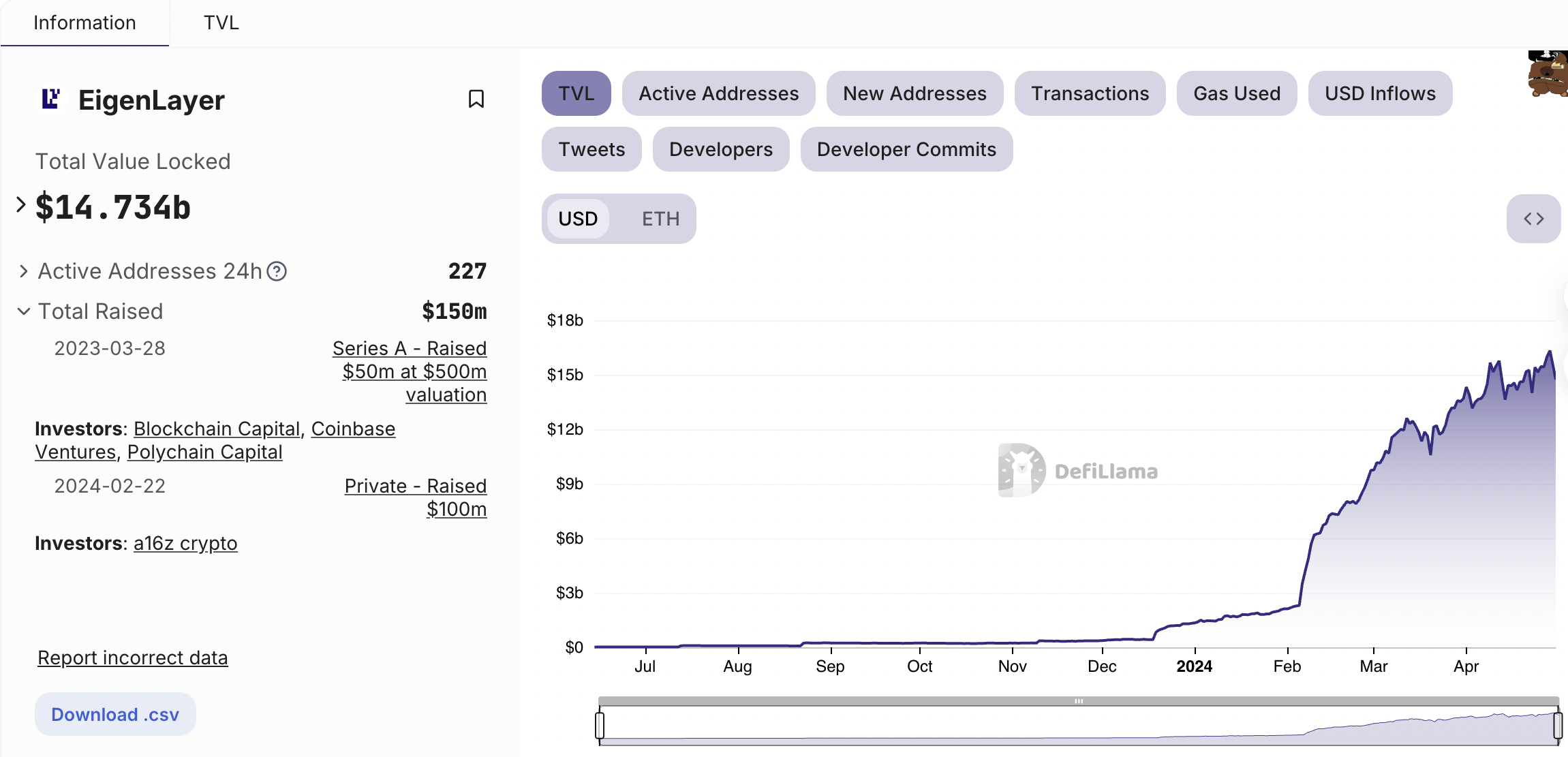
The advent of EigenLayer has certainly catalyzed a new era of trust and security in the world of Ethereum. By empowering stakers to restake their ETH and simultaneously opt into multiple platforms, EigenLayer creates a shared security pool that strengthens the safety of various applications. This innovative approach not only reduces capital requirements for stakers, but also enhances trust assurances for individual services. It solves the “cold start” problem when creators of new decentralized Ethereum services struggled to establish a unique trust network to secure their systems. EigenLayer eliminates this challenge by providing a solution that enables any service, regardless of its nature, to access the collective security of Ethereum stakers. As of today, EigenLayer has a mind-blowing TVL of $14.73 billion. Within the emerging liquid restaking space, Renzo and EtherFi are the two major players.

The good, the bad and the ugly
On a positive note, you can say that liquid restaking enables shared security and thus enhances the security of the entire crypto system. However, it is important to also acknowledge the flip side of this coin. LRT has the power to significantly increase the leverage of the entire crypto ecosystem, which has been a cause for concern in the past. While this may currently only affect the Ethereum ecosystem, any further spread of LRT could potentially amplify the leverage throughout the entire crypto system. It is worth noting that excessive leverage has been cited as one of the major causes of stock market crashes in history, and as such, caution must be exercised in the implementation of LRT. As we continue to witness the evolution and growth of the crypto world, only time will tell how this increased leverage will ultimately play out. Let us wait and see.