The viewpoints on climate financial instruments have always been mixed. For instance, some say carbon credits are useless. It is just another tool for financial players to reap profit. The real hope in achieving the net zero goal is to invest in the technologies and hardware that directly reduce the carbon emission. Yet, I disagree. The climate case for carbon credits, or “X” credit for the purpose of this blog post is undeniable. Some arguments supporting the use case of climate financial instruments:
Set the incentive framework right, the actions will follow. Charity and donations can only get you so far. The right financial incentive needs to be put into places to ensure sustainable investments into technologies and facilities that might not materialize in the short run.
Quantify impact in order to measure progress. Without clear metrics and standards which will be available in an effective carbon credit market for example, the market participants are operating in the dark. The confusion will discourage participation and hinder progress. To achieve the net zero goal, we must scale fast.
Financial instrument is an effective tool to facilitate concerted efforts among different stakeholders. By providing a platform for strategic collaboration, these instruments can help form alignment and increase the efficiency of capital flows.
Major financial instruments in climate
Carbon credit
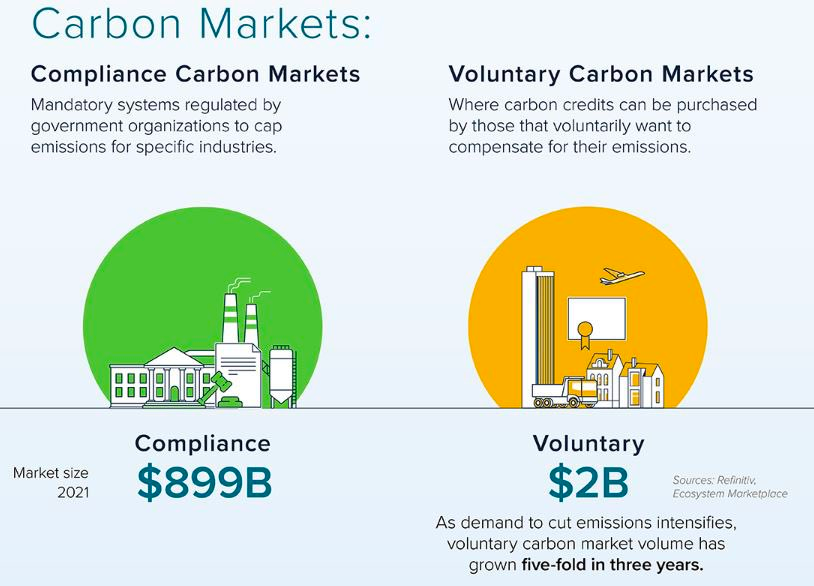
Carbon credit is the largest and most developed financial instrument in climate. One carbon credit equals to one tonne of carbon emission. There are two types of carbon market: compliance market and voluntary market. The compliance market is designed to help countries meet their obligations under the Paris Agreement. Compliance market is run by national or international governance bodies. Most compliance markets adopt a “cap and trade” model — puts a limit on the amount of pollutants a country can emit and then allocates allowances for each country to reach its target. Companies that exceed their allowances must purchase credits from those who have not used all of their allowances. The voluntary market, however, is not regulated by policy and instead encourages companies to reduce emissions over a set period of time through the purchase of carbon credits. These credits are investments in emissions reduction projects that benefit the environment and help reduce the company’s overall carbon footprint.
According to Refinitiv, the global compliance carbon market was valued at approximately $899 billion. According to Ecosystem Marketplace, the global voluntary carbon market was valued at just about $2 billion but is expected to grow rapidly as the demand to cut emission intensifies.

Within voluntary carbon market, we have nature-based carbon credits and technological carbon credits. Nature-based carbon credits allow companies to reduce their emissions by investing in projects that can sequester carbon from the atmosphere (such as reforestation, soil carbon sequestration, and wetland restoration) or water (the protection and management of coastal and marine ecosystems). The carbon credits created from forest or land-based conservation projects are normally called “green” carbon credits. The carbon credits generated from preservation of coastal and marine ecosystems are “blue” carbon credits. Nature-based carbon credits provide financial incentives for businesses to invest in these projects and help to mitigate the impacts of climate change. Additionally, they can also create employment opportunities for the local community and help conserve natural resources.
Technological carbon credits are often called CDRs. For details on technologies that generate CDRs, please read my previous blog post. Nature-based carbon credits are viewed as short-term solutions while CDRs are viewed as more permanent solutions to tackle climate change. Not all carbon credits are equal. At the writing of this blog post, nature-based carbon credit is trading in the range of $2 – $15 while CDR is trading in the range of $200 – $700.
Plastic Credit
A plastic credit is a transferable certificate representing the collection of one tonne of plastic waste recovered or recycled that would otherwise have ended up in the natural environment.
Similar to carbon credit, plastic credit creates financial incentives for companies to reduce plastic waste and therefore reduce pollution to the environment. The proceeds from credit sales go to fund efforts to reduce plastic pollution. This could include funding clean-up operations, research into more sustainable manufacturing processes, or incentives for consumers to reduce their use of single-use plastics. The following is a flow chart that shows the creation of plastic credits.

Biodiversity Credit
Nothing alarms humanity more than a global pandemic on the consequence of biodiversity destruction. Biodiversity credits, also known as habitat credits, are a tool that can be used to conserve and protect biodiversity. Unlike biodiversity offsets, which are payments made to compensate negative outcome caused by human activities, biodiversity credit is a financial instrument that fund nature-positive projects through the creation and sales of credit units.
The concept of biodiversity credits involves creating or preserving habitats for endangered or threatened species, or restoring degraded ecosystems. These projects are then certified and awarded credits based on the amount of biodiversity they are able to conserve or restore.
WEF has done considerable work on biodiversity credit. If you are interested to learn more about it, I highly recommend read the WEF blog post here.

Overall, the climate market is flourishing at unprecedented speed. Yet it still falls short of the speed and scale required to reach the net zero goal required for human survival by 2050. Substantial efforts and resources are needed to save the environment, or, to save ourselves.