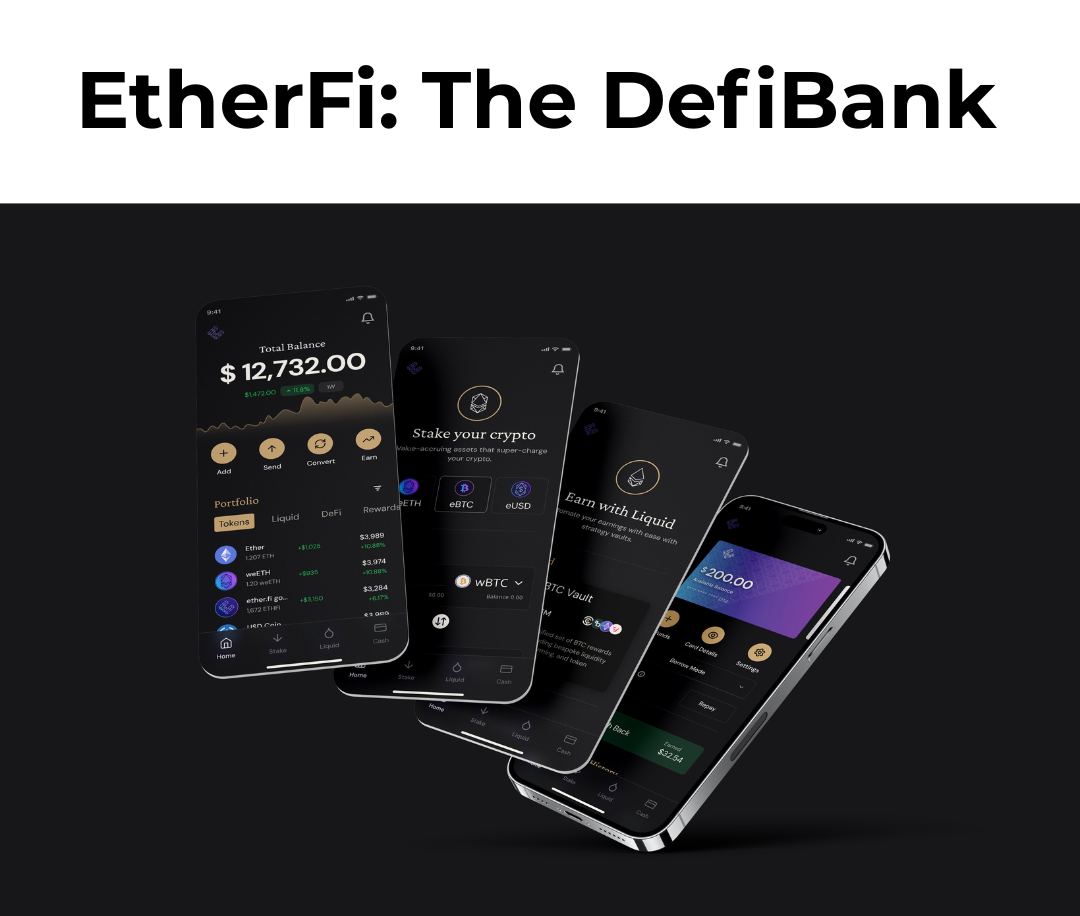
The decentralized banking may already be here—and it runs on EtherFi.
DeFi 2.0, Beyond Stablecoin and Meme
In 2025, the crypto world is moving past the hype of stablecoins and memecoins to a more transformative story: decentralized finance (DeFi) as the backbone of everyday banking. Enter EtherFi, a protocol that’s evolved from Ethereum’s restaking giant to the world’s first “Defibank.” With a staggering 6,159% TVL growth in 2024, soaring from 45,770 ETH to 2.57M ETH, EtherFi is no longer just a DeFi player. It is becoming a non-custodial Defibank providing an alternative “banking” experience, onchain.
What is a Defibank? What Does It Do?
EtherFi’s Defibank reimagines banking as a non-custodial, DeFi-powered platform, delivering traditional financial services (saving, spending, borrowing ) through three core product lines: Stake, Liquid, and Cash. The Stake product lets users lock ETH, BTC, or USD-based assets on Ethereum’s blockchain to earn high yields (often 5–10% APY), rivaling traditional savings accounts but with decentralized transparency. Liquid introduces flexibility via restaking tokens (e.g., weETH), allowing users to access liquidity or borrow against staked assets without selling, productizing DeFi’s complex strategies for mainstream ease. The Cash product, a Visa-backed card, enables users to spend crypto yields or manage bill payments and payroll, blending DeFi with daily life. With $13B in restaking TVL and a user-controlled, private-key model, EtherFi’s Defibank makes financial empowerment intuitive, scalable, and secure, as CEO Mike Silagadze underscores with the platform’s near-instant profitability.
Key Differences vs. a Traditional Bank or a Neobank
EtherFi’s Defibank stands apart from traditional banks and even neobanks like Chime or Revolut by embracing DeFi’s core principles: decentralization, transparency, and user sovereignty. Unlike traditional banks, which hold your funds, charge fees, and offer meager interest, EtherFi’s non-custodial model lets users earn high crypto yields and avoid intermediaries. Compared to neobanks, which streamline fiat banking but remain centralized, EtherFi offers true financial freedom—users can borrow against Bitcoin without credit checks or spend staking rewards at Starbucks via the Cash card.
However, it’s not without challenges: DeFi’s complexity and regulatory uncertainty contrast with the plug-and-play simplicity of neobanks.
Path to $1B+ Revenue DeFi Protocol
While challenges like regulatory hurdles remain, EtherFi’s non-custodial vision of modern banking is inspiring, and provides a compelling offer that rivals traditional banking.