Raising $30 billion doesn’t eliminate existential risk. In AI, capital buys time, not certainty.
While the headlines are obsessed with the $380B valuation, Dario Amodei is focused on a much darker reality. In his recent interview, he didn’t sound like a founder doing a victory lap; he sounded like a risk manager staring at a spreadsheet that refuses to balance.

The “10x Growth” Trap
The core of the problem is the seduction of recent history. Anthropic has enjoyed a defying-gravity growth curve: from virtually zero, to ~$100M, to ~$1B, and now to ~$14B in annualized revenue. That is roughly 10x growth, year over year, for three years straight.
The danger is that the market (and the capex planning) assumes this line will continue. But the law of large numbers is undefeated. Growing 10x from $100 million is “easy.” Growing 10x from $14 billion—to $140 billion in a single year—is historically unprecedented.
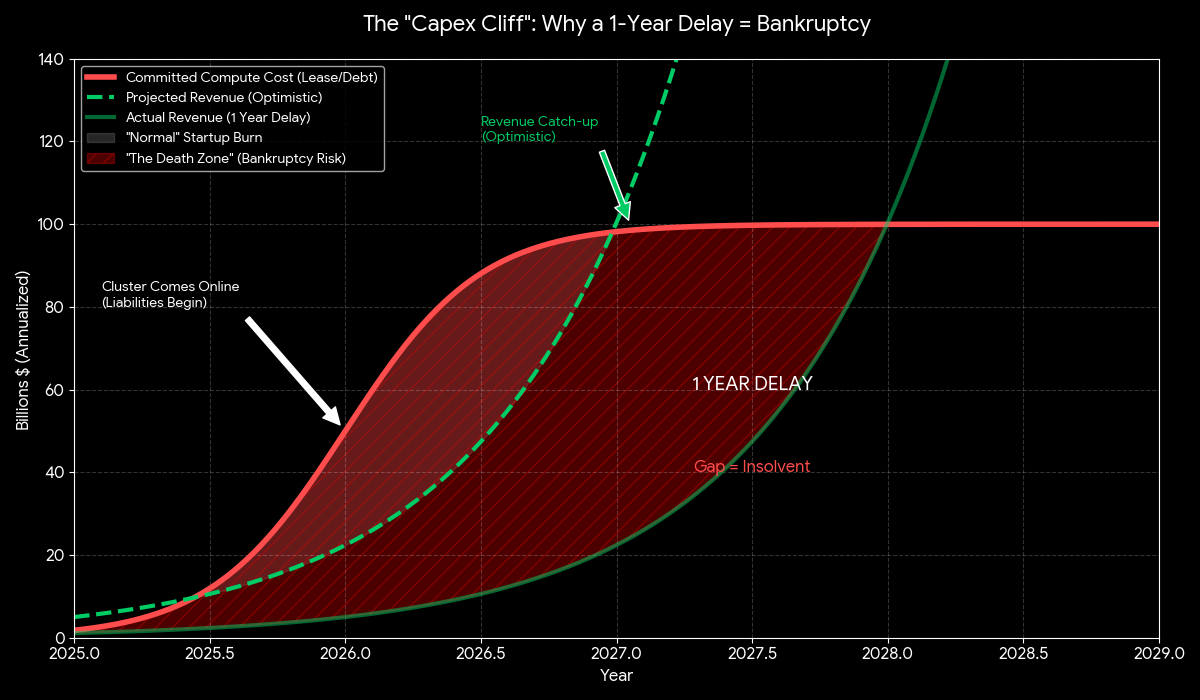
Amodei’s specific warning is that their infrastructure commitments are being made today based on tomorrow’s growth. If they commit to a trillion-dollar cluster assuming the “10x” curve holds, but growth slows to a “mere” 2x or 3x, the math breaks instantly.
The Capex Cliff
This creates what insiders call the “Capex Cliff.” Compute is not an asset; it is a fixed liability. When you sign a lease for a gigawatt-scale cluster for 2027, you owe that money whether the revenue arrives or not.
If the AI model is delayed by just 12 months, or if revenue growth dips from “exponential” to “linear,” the company enters a financial “death zone.” They are left holding a massive bill for depreciating hardware without the cash flow to service it. Banks won’t lend against a distressed data center that burns electricity but generates no cash.
That is the “insolvency event” Amodei is hedging against. The massive $30B capital raise isn’t for aggression; it’s an insurance policy against the growth curve normalizing.
The Takeaway: From “Science” to “Solvency”
For the last three years, the dominant constraint in AI was Capability (Can the model get smarter?). For the next three years, the dominant constraint becomes Solvency (Can the revenue service the lease?).
Amodei is betting that the winner of the AI race won’t necessarily be the lab with the smartest model in 2028. It will be the lab that didn’t accidentally commit suicide in 2027.
As we watch these companies navigate the “Death Zone,” look at the utilization rates. If Anthropic’s next cluster is running at 100% capacity for paying customers, they win. If they are burning gigawatts just to “train the next version” without current revenue paying the electric bill, the cliff is approaching.
The $30B raise didn’t solve the risk. It just bought them a slightly longer runway to land the plane.