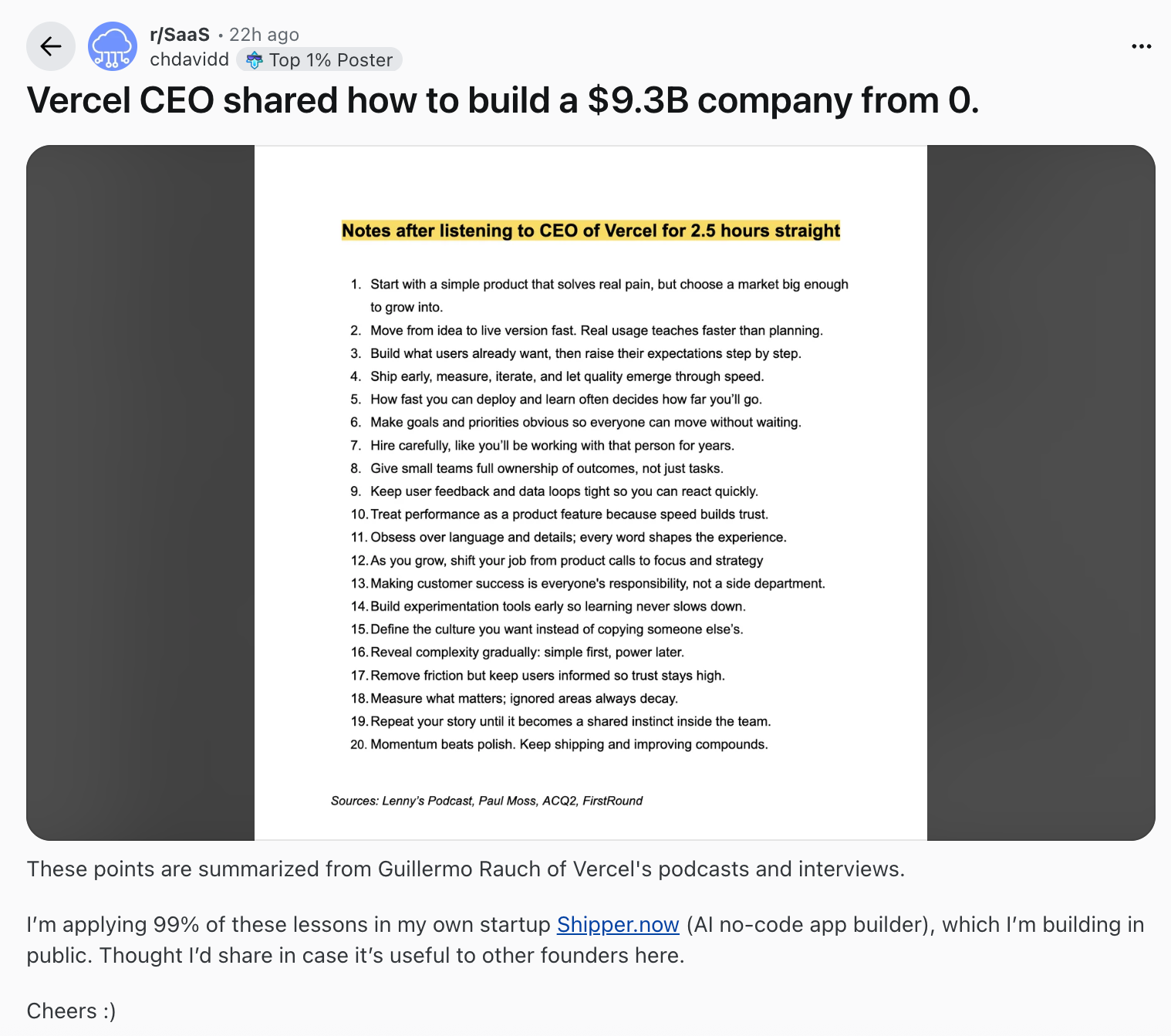
I came across this viral thread on Reddit summarizing Guillermo Rauch’s (CEO of Vercel) insights on building a $9.3B company from scratch. It is pure gold: raw, actionable advice drawn from podcasts like Lenny’s and Acquired.
What strikes me most from a financial lens? These principles aren’t just about product and culture; they’re a blueprint for efficient capital allocation, minimizing burn, and maximizing growth. Here is my spin on how they drive fiscal health and investor appeal.
1. Start simple, but in a massive market
Solve a real pain with an MVP, but pick a TAM that supports 10x growth. From a finance perspective, this keeps your initial burn low while positioning for VC interest.
2. Ship fast, learn from real usage
Ditch endless planning for quick iterations. From a finance view, this accelerates your path to product-market fit, reducing wasted runway and improving metrics like LTV/CAC ratios.
3. Raise user expectations incrementally
Build what they want now, then level up. This fosters retention and upsell opportunities, turning one-time users into recurring revenue streams.
4. Speed = quality through iteration
Deploy often, measure everything. Faster cycles mean quicker pivots, lower opportunity costs, and stronger unit economics.
5. Clear goals empower autonomous teams
Make priorities obvious so teams move independently. Financially, this scales ops without bloating headcount, controlling overhead and boosting ROI on talent.
6. Hire for the long haul
Choose people like you’ll work with them for years. Bad hires drain resources (e.g. severance, retraining costs). Good ones? They amplify productivity and help hit milestones that unlock funding rounds.
7. Own outcomes, not tasks
Give teams full responsibility. This aligns incentives, reduces silos, and ensures every dollar spent ties directly to revenue impact.
8. Tight feedback loops
React quickly to user data. In CFO terms, this is real-time KPI monitoring: spot churn early, optimize pricing, and avoid the death spiral of ignored metrics decaying your balance sheet.
9. Customer success is everyone’s job
Not just support’s. This builds loyalty and advocacy, driving organic growth and higher valuations through network effects, far cheaper than paid acquisition.
10. Momentum over perfection
Ship, improve, repeat. Compounding wins here: consistent progress attracts talent and capital, while chasing perfection burns cash without traction.
Vercel’s journey from zero to billions shows how these habits create defensible moats and explosive value. In my work with SaaS founders, applying even half of these has helped extend runways by 6-12 months and prep for funding rounds.
Which of these resonates most for your startup?